
The 30-share Sensex jumped 729 points to end at 28,076 and the 50-share Nifty soared 217 points to end at 8,494.

Regardless of market levels, invest in stocks and equity mutual funds in a staggered manner.

India, who defeated England by five wickets in the fourth Test in Ranchi to take an unassailable 3-1 lead in the five-match series, replaced the Kiwis with a stronger points percentage of 64.58.


Benchmark share indices trimmed intra-day gains after global crude oil prices resumed their downward trajectory after sharp gains on Friday.
Emerging business theme-based funds basically invest into mid and small-cap stocks, which normally have the potential to grow faster.
The BSE benchmark Sensex on fell by 54 points in early trade due to profit-booking after two sessions of gains amid disappointing industrial production and retail inflation data.

The rising market poses a dilemma for investors on whether to continue buying, reduce equity holding, or exit equities altogether.

rediffGURU Ramalingam Kalirajan answers your personal finance queries.
BSE small-cap index, which ended over 1% higher, outperformed the benchmarks significantly.

They have returned 62 per cent this year.

Reliance Industries Limited is the country's most valued firm with a m-cap of Rs 9,17,953.13 crore followed by TCS Rs 8,04,980.33 crore.

Long-term investors should consider moving into smaller stocks. Rather than try to pick stocks, it makes sense to build a diversified portfolio by exposure across midcap and small caps funds, suggests Devangshu Datta.

Leader of the Opposition in the Lok Sabha Rahul Gandhi asserted that the Congress will protect the Constitution and the reservation system at all costs and foil "conspiracies" of the Bharatiya Janata Party.

With the markets scaling new highs, as many as 43 stocks from the Nifty50 index and 27 of the 30 scrips that are part of the S&P BSE Sensex are trading above their respective 200-day moving average (DMA). The 200-DMA is seen as one of the most relevant trend indicators by investors and traders, who believe that stocks and indices trading above this level possess strength and are likely to rally in the short to medium term, while the ones trading below this level are viewed as bearish and expected to see a sell-off. Wipro, UPL, Kotak Mahindra Bank, Hindalco, Infosys, Cipla, and Adani Enterprises are the only stocks from the Nifty50 pack that are still below their respective 200-DMA, the exchange data suggests.
The ongoing stock market turbulence does not seem to have affected much the country's top corporate houses, with the collective valuation of biggest five of them growing by over $100 billion in the fiscal ended on March 31. The worth of India's five most-valued business houses, as measured by market capitalisation of their listed group firms, stood at $ 290.1 billion (Rs 11,61,000 crore) at the end of Monday's trading.
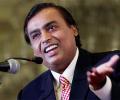
At market close, the oil-to-telecom conglomerate's market capitalisation (m-cap) zoomed to Rs 10,01,555.42 crore on BSE.

New Zealand's combination of quality spin bowling and sharp fielding gives them a good chance of winning a maiden T20 World Cup title in Australia this year, in-form batsman Glenn Phillips said.

The gap between the highs and the lows in April for the benchmark S&P BSE Sensex was just 4.1 per cent - the narrowest since July 2021 and nearly half its three-year average. The absence of major positive triggers, sectoral rotation, and cautiousness due to earnings and economic uncertainty have kept a tight leash on the markets, observe experts. Remarkably enough, during the 17 trading sessions in April, the Sensex didn't even log an advance or a decline of more than 1 per cent.

In the Sensex pack, ICICI Bank emerged as the top gainer by rising 0.97 per cent, while Tata Steel advanced 0.92 per cent.
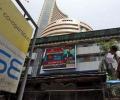
Among the Sensex constituents, as many as 16 stocks closed with losses with Nestle India, Kotak Mahindra Bank, IndusInd Bank, Bajaj Finserve, Titan and JSW Steel being the major laggards. Index major Reliance, Hindustan Unilever, Maruti and Tata Steel also declined due to selling pressure. In contrast, NTPC, TCS, Tech Mahindra, Bajaj Finance bucked the trend and ended the day in green. Axis Bank, Bharti Airtel, Mahindra & Mahindra and Tata Motors also defied the trend.

'The people preferred Uddhav Thackeray and Sharad Pawar...'

'Rather than taking a very short-term view on the markets, equity investing should be premised on longer term growth opportunities.'

Tata Steel fell the most by 4.21 per cent. NTPC, Tata Motors, HCL Technologies, Mahindra & Mahindra, State Bank of India, Power Grid, Tech Mahindra, Larsen & Toubro and JSW Steel also declined. HDFC Bank was the only gainer from the pack. In Asian markets, Seoul, Tokyo and Hong Kong settled in the positive territory while Shanghai ended lower.

RIL was among the top gainers in the Sensex pack, jumping over 3 per cent to hit its record closing high. Tech Mahindra, HCL Tech, Bharti Airtel, Infosys, HUL and ITC were also among the prominent gainers.

TCS emerges as the biggest gainer
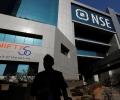
The benchmark Nifty and Sensex could see another 8-10 per cent from the current levels, said HDFC Securities in its outlook for equity markets in 2024. The brokerage said that the market movement in the next year will not be linear, and there will be more volatility. When asked about the market reaction to the General Elections in 2024, Dhiraj Relli, managing director and CEO of HDFC Securities, said more than the outcome of the elections, the market movement in the next three to four months will decide the market trajectory post elections.

Reliance has significant investments in telecom, consumer retail and media businesses in India.

IMAGES from the 4th T20I played between Zimbabwe and India in Harare, on Saturday.

The unexpected interest rate hike by the RBI on Wednesday will have the banking system on average making a 10-15 bps gains on the yields, with private banks making larger gains as 57 per cent of their loans are linked to external benchmark rate and 40 per cent to the marginal cost of lending rates, as per a report. Stating that lenders and borrowers will face volatile times with the Reserve Bank raising the repo rate by 40 bps to 4.40 per cent and the cash reserve ratio (CRR) by 50 bps on May 4 in an off-cycle policy move, India Ratings said the market rates had already been moving higher before the move. The 364-day T-bills have moved up 120 bps and 10-year G-sec by 140 bps since May 2020, when the repo rate was cut to a record 4 per cent, which led to an expectation of a faster and sharper rise in interest rates in the system but the central bank stayed the course to support the fragile economy battered by the pandemic.

Tata Steel, Tech Mahindra, NTPC, JSW Steel, Power Grid, UltraTech Cement, HCL Technologies and HDFC Bank were among the major gainers. Bharti Airtel, Hindustan Unilever, Axis Bank, Reliance Industries, Kotak Mahindra Bank, ICICI Bank and IndusInd Bank were among the laggards.

Patidar looked assured in his 72-ball 32 and one of his three boundaries came via a reverse sweep.

Seven of the 10 most valued domestic companies together added Rs 1,31,173.41 crore in market valuation last week, with HUL and TCS emerging as the biggest gainers. Reliance Industries, Infosys, HDFC, Bajaj Finance and Wipro also saw a rise in their market valuations, while HDFC Bank, ICICI Bank and SBI suffered losses. The market capitalisation (m-cap) of Hindustan Unilever Limited (HUL) zoomed Rs 50,234.21 crore to Rs 6,15,016.63 crore.

Sticking to smaller and mid-cap companies can be more fruitful, suggests Devangshu Datta.

TCS, HDFC Bank, Infosys and Kotak Mahindra Bank were the other firms in the top-10 list which witnessed a rise in their market capitalisation. On the other hand, HUL, HDFC, Bharti Airtel, ITC and ICICI Bank finished with losses.

The 50-share NSE Nifty, however, was little changed, ending 1.20 points down

'Sell part of your portfolio where you're making good money, especially in small caps and mid caps.' 'The money which you take home is yours. The money which is there on paper is not yours.

With the reality of coalition politics staring the BJP in its face, this was inevitable, points out Ramesh Menon.

'We expect the bull-market phase to still persist, but now led by large-caps which offer better valuation and benefit from FII inflows.'
'We expect continued pressure on midcaps, but any sharp correction looks unlikely from here on.'
